
Emergent Quantum Mechanics and beyond
If one can say that much of traditional science operates by an implicit linear mapping of objects of knowledge onto observing knowledge acquisitors (i.e., by linear information transfer from objects to observers), then one may very well characterize the present situation in the natural sciences as one of a movement towards a «nonlinear», e.g. circular, relation between objects of knowledge and their investigators (observers). Recursive models, feedback loops, emergence of complex behavior and structures, just to highlight some ideas, are such new modeling devices derived from a nonlinear ansatz.
Concerning the formal meaning of the word, the extension of linear models in the sciences to nonlinear ones has opened vast new areas of research, including investigations of systems with unprecedented degrees of complexity.
- EmQM17
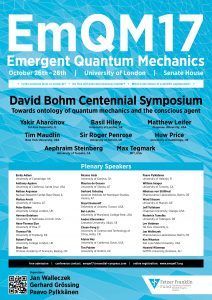 Towards Ontology of Quantum Mechanics and the Conscious Agent. David Bohm Centennial Symposium, in the framework of the 4th International Symposium about Quantum Mechanics based on a »Deeper Level Theory« (Emergent Quantum Mechanics – EmQM17), University of London, 26-28 October, 2017.Conference webpage. Objectives The symposium explored the possibility of an ontology for quantum mechanics. The resurgence of interest in realist … Weiterlesen: EmQM17
 - Implications of a deeper level explanation of the deBroglie-Bohm version of quantum mechanicsElements of a „deeper level“ explanation of the deBroglie-Bohm (dBB) version of quantum mechanics are presented. Our explanation is based on an analogy of quantum wave-particle duality with bouncing droplets in an oscillating medium, the latter being identified as the vacuum’s zero-point field. A hydrodynamic analogy of a similar type has recently come under criticism by Richardson et al., because … Weiterlesen: Implications of a deeper level explanation of the deBroglie-Bohm version of quantum mechanics
- EmQM15The Third International Symposium on Emergent Quantum Mechanics. The symposium invites the open exploration of the quantum state as a reality. The resurgence of interest in ontological quantum theory, including both deterministic and indeterministic approaches, challenges long held assumptions and directs focus towards the following questions: Is the world local or nonlocal? What is the nature of quantum nonlocality? If … Weiterlesen: EmQM15
- Extreme beam attenuation in double-slit experiments: Quantum and subquantum scenarios
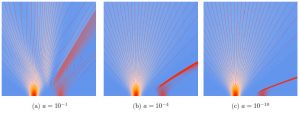 We show that during stochastic beam attenuation in double slit experiments, there appear unexpected new effects for transmission factors below 10-4, which can eventually be observed with the aid of weak measurement techniques. These are denoted as quantum sweeper effects, which are characterized by the bunching together of low counting rate particles within very narrow spatial domains. We employ a … Weiterlesen: Extreme beam attenuation in double-slit experiments: Quantum and subquantum scenarios
 - EmQM13
 The EmQM13 conference took place 23-25 october 2015 in Vienna, Austria. 2nd International Symposium about Quantum Mechanics based on a »Deeper Level Theory« The symposium invites the open exploration of an emergent quantum mechanics, a possible »deeper level theory« that interconnects three fields of knowledge: emergence, the quantum, and information. Could there appear a revised image of physical reality from … Weiterlesen: EmQM13
 - EmQM11Conference Emergent Quantum Mechanics (EmerQuM11 or EmQM11) On the occasion of Heinz von Foerster’s 100th birthday EmerQuM11 conference webpage 10 – 13 November 2011, University of Vienna, Austria The theme of „emergent quantum mechanics“ is, we believe, an appropriate present-day topic, which can both serve as an illustration of von Foerster’s intellectual heritage and, more generally, as a means to … Weiterlesen: EmQM11
- An Explanation of Interference Effects in the Double Slit Experiment: Classical Trajectories plus Ballistic Diffusion caused by Zero-Point FluctuationsA classical explanation of interference effects in the double slit experiment is proposed. We claim that for every single „particle“ a thermal context can be defined, which reflects its embedding within boundary conditions as given by the totality of arrangements in an experimental apparatus. To account for this context, we introduce a „path excitation field“, which derives from the thermodynamics … Weiterlesen: An Explanation of Interference Effects in the Double Slit Experiment: Classical Trajectories plus Ballistic Diffusion caused by Zero-Point Fluctuations
- Emergence and Collapse of Quantum Mechanical Superposition: Orthogonality of Reversible Dynamics and Irreversible Diffusion
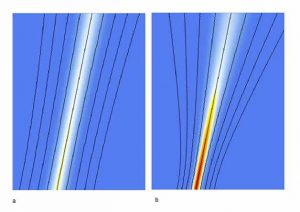 Based on the modelling of quantum systems with the aid of (classical) non-equilibrium thermodynamics, both the emergence and the collapse of the superposition principle are understood within one and the same framework. Both are shown to depend in crucial ways on whether or not an average orthogonality is maintained between reversible Schrödinger dynamics and irreversible processes of diffusion. Moreover, said … Weiterlesen: Emergence and Collapse of Quantum Mechanical Superposition: Orthogonality of Reversible Dynamics and Irreversible Diffusion
 - Derivation of the Exact Schrödinger EquationBy assuming that a particle of energy hbar.omega is actually a dissipative system maintained in a nonequilibrium steady state by a constant throughput of energy (heat flow), the exact Schroedinger equation is derived, both for conservative and nonconservative systems. Thereby, only universal properties of oscillators and nonequilibrium thermostatting are used, such that a maximal model independence of the hypothesised sub-quantum … Weiterlesen: Derivation of the Exact Schrödinger Equation
- On the Thermodynamic Origin of the Quantum PotentialThe quantum potential is shown to result from the presence of a subtle thermal vacuum energy distributed across the whole domain of an experimental setup. Explicitly, its form is demonstrated to be exactly identical to the heat distribution derived from the defining equation for classical diffusion-wave fields. For a single free particle path, this thermal energy does not significantly affect … Weiterlesen: On the Thermodynamic Origin of the Quantum Potential
- A Serious Matter: The John-Bell – ScandalGerhard Groessing16.12.2000 In a festive lecture at the University of Vienna in 1987, on the occasion of Erwin Schrödinger’s 100th birthday, the famous physicist John Bell complained about the «scandal» (literally) that the so-called «deBroglie-Bohm interpretation» (BBI) of quantum theory was not taught at the universities and treated on an equal footing with the predominant «Copenhagen interpretation». On the contrary, … Weiterlesen: A Serious Matter: The John-Bell – Scandal
- Wasser als Vor-Bild zur NaturforschungGerhard Grössing Von Ebenen-Unabhängigkeit zu Ebenen-Verknüpfung Die Entwicklung der theoretischen Physik im 20. Jahrhundert ist grösstenteils durch eine streng reduktionistische Haltung charakterisierbar, die ein detailliertes Bild vom hierarchischen Aufbau der materiellen Welt geliefert hat. Obzwar immer wieder Bestrebungen nach der einen «Weltformel» (oder nach der Theory of Everything) zu registrieren sind, ist doch ein wesentliches Resultat der auf dieser Haltung … Weiterlesen: Wasser als Vor-Bild zur Naturforschung
- Quantum Interferometry – «Late-Choice» ExperimentsWe have been particularly interested in nonlocal effects, whose explanation remains somehow «mysterious» within the linear framework but becomes a natural one within the framework of quantum cybernetics. The prominent candidate of a corresponding experiment is a modification of Wheeler’s delayed-choice experiment, i.e. a time-dependent modification of the («macroscopic») boundary conditions in so-called late-choice experiments. As far as the present … Weiterlesen: Quantum Interferometry – «Late-Choice» Experiments
- Fractal Evolution – Hierarchically Emergent Fractal Evolution (HEFE)We have discovered a universal dynamical property in discrete systems (like QCA or CML) which we call fractal evolution.It is observed in lattice models if any additional temporal feedback operation is introduced (involving some memory of the system’s states or some randomly generated mechanism) and if a normalization procedure after each time step is performed. Fractal evolution is characterized by … Weiterlesen: Fractal Evolution – Hierarchically Emergent Fractal Evolution (HEFE)